


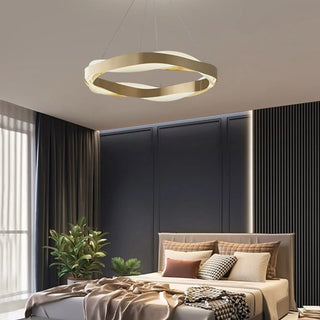
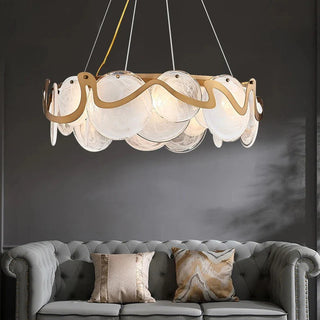

Quick answer: Ring and round chandeliers use a circular halo, orbital ring, or drum silhouette for even light and a clean, architectural look. Hang the lowest point about 7 feet above the floor, or 30–36 inches above a tabletop. They're especially popular over round dining tables and in open-plan living rooms, and range from about $560 to $1,800+ in gold, chrome, rose gold, and black.
Ring vs. round: what's the difference?
The terms overlap, but there's a useful distinction:
- Ring chandeliers are open in the center — a circular band or halo of light (often LED) with little or nothing filling the middle. The effect is architectural and minimal, closer to a piece of wall art than a traditional chandelier.
- Round chandeliers may still be circular in overall shape but are more filled-in — a round drum shade, a cluster of round elements, or a circular arrangement of crystal that reads as a solid form rather than an open halo.
Both work by spreading light evenly in a circle, which is what makes them a natural fit for round tables and symmetrical rooms.
Single halo vs. multi-ring designs
- Single halo: one ring, minimal and modern — the strongest choice when you want the fixture itself to disappear into the architecture rather than compete for attention.
- Concentric multi-ring: two or three rings of different diameters stacked or nested, for more visual complexity and a fuller look in larger rooms.
- Crystal-wrapped rings: rings or circles wrapped in crystal strands or blocks, combining the architectural ring shape with traditional sparkle.
Why they suit round tables
A round or ring chandelier's circular symmetry echoes a round table's shape directly, which is why designers reach for this style over round dining tables specifically — a rectangular or linear chandelier over a round table can look visually mismatched, where a ring or round design doesn't have that problem.
They also work well in open-plan living rooms, where a symmetrical fixture reads as a centerpiece from every angle rather than having a "front" side.
Finishes available
Ring and round chandeliers come in gold, chrome, rose gold, and black, plus combination finishes like gold-and-black or gold-and-chrome. Rose gold in particular is more common in this shape than in others, since the soft circular form pairs naturally with a softer metal tone.
How to size one
- Measure the table or room. Over a table, aim for a chandelier diameter roughly half to two-thirds the table's width. In open floor space, size relative to the room — a single halo in a small breakfast nook should be noticeably smaller than one centered in a great room.
- Set the height. Hang the lowest point 30–36 inches above a tabletop, or about 7 feet above the floor in open space.
- Match ring count to room size. A single halo suits smaller rooms or a minimal look; concentric multi-ring designs fill larger rooms without needing one oversized ring.
Where they work best
- Round dining tables: the natural first choice — a ring or round chandelier directly echoes the table shape.
- Open-plan living rooms: a symmetrical fixture that looks intentional from any seating angle.
- Bedrooms: a smaller single-halo ring chandelier works as a statement piece in place of a ceiling fan or flush mount.
- Entryways: a round or ring design centered in a foyer reads as architectural rather than ornate.
Bottom line
Choose a ring chandelier for a minimal, architectural halo effect, or a round chandelier for a fuller circular form with more visual weight. Either way, they're the natural pairing for a round table or a symmetrical, open-plan room — size the diameter to your table or space, and keep the same 30–36 inch or 7-foot hanging rules as any other chandelier shape.
Not sure which fixture fits your space?
Send room size, ceiling height and a photo. Our team will suggest sizes and models that fit your project.
Not sure which fixture fits your space?
Send room size, ceiling height and a photo. Our team will suggest sizes and models that fit your project.