


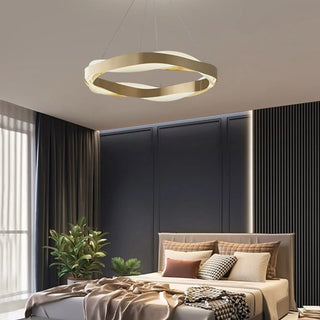
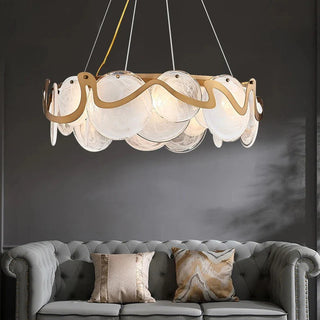

Quick answer: Black chandeliers read as modern and bold, and pair with almost any palette — white, wood, marble, or jewel tones. Gold and brass chandeliers read as warmer and more traditional-leaning, and flatter navy, emerald, cream, and walnut tones especially well. Both finishes hang the same way: lowest point about 7 feet above the floor, or 30–36 inches above a dining tabletop.
The short version
Neither finish is objectively better — they do different jobs. Black adds contrast and reads as a deliberate, modern statement against almost any backdrop. Gold adds warmth and glow, and tends to feel more traditional or glamorous depending on the shape it's paired with. If you're not sure, look at your existing hardware: black chandeliers pair naturally with black door hardware, window frames, or furniture legs; gold pairs with brass fixtures, faucets, and picture frames already in the room.
Black chandeliers
Black chandeliers work by contrast. Set against a white ceiling or wall, a black fixture becomes a graphic, architectural element rather than blending in — which is why they suit modern and transitional interiors especially well. Because black is a neutral rather than a warm or cool tone, it pairs with nearly any wall color or material: white, wood, marble, or saturated jewel tones like emerald or navy all work.
Black chandeliers are available in the same range of shapes as other finishes — drum, rectangle, ring, and round — plus black-and-gold combination pieces that soften pure black with warmer metal accents. Compact drum or ring designs work in bedrooms; grand multi-tier pieces suit living rooms and staircases.
Gold and brass chandeliers
Gold and brass chandeliers work by warmth. Rather than contrasting with a room, a gold fixture tends to pick up and reflect other warm tones already present — wood floors, cream walls, brass hardware — which is why designers often describe gold as flattering to both traditional and modern rooms, as long as there's some warmth elsewhere in the palette to connect to.
Gold designs range from minimalist LED rings and spirals to grand three-tier crystal centerpieces, plus icicle and dandelion-shaped pieces for a more sculptural look. Rose gold and gold-chrome combination finishes offer a middle ground for rooms with mixed metal hardware already.
Side-by-side comparison
| Black chandeliers | Gold chandeliers | |
|---|---|---|
| Best for | Modern, transitional, high-contrast rooms | Traditional, warm, glam-leaning rooms |
| Pairs with | White, wood, marble, jewel tones | Navy, emerald, cream, walnut |
| Visual effect | Bold, architectural, graphic | Warm, glowing, soft-lit |
| Common shapes | Drum, rectangle, ring, round | Ring, icicle, dandelion, tiered crystal |
| Price range | ~$500–$2,100+ | ~$480–$3,000+ |
Sizing and hanging height (applies to both)
- Over a dining table: hang the lowest point 30–36 inches above the tabletop, with a fixture diameter roughly half to two-thirds the table's width.
- In open floor space: on an 8–10 foot ceiling, hang the lowest point about 7 feet above the floor.
- High ceilings: add roughly 3 inches of total fixture height (chain, rod, and shade combined) for every foot of ceiling height above 8 feet.
Can't decide? Consider a combination finish
Black-and-gold combination chandeliers exist specifically for this situation — a black frame or crystal with gold accents (or the reverse) gives you both the contrast of black and the warmth of gold in one fixture, which can be an easier call in a room with genuinely mixed metal tones already.
Bottom line
Choose black for contrast and a modern, graphic statement; choose gold for warmth and a softer, more traditional-leaning glow. Both come in the same shapes and hang by the same rules, so the decision really comes down to which effect — contrast or warmth — your room needs more of.
Not sure which fixture fits your space?
Send room size, ceiling height and a photo. Our team will suggest sizes and models that fit your project.
Not sure which fixture fits your space?
Send room size, ceiling height and a photo. Our team will suggest sizes and models that fit your project.