


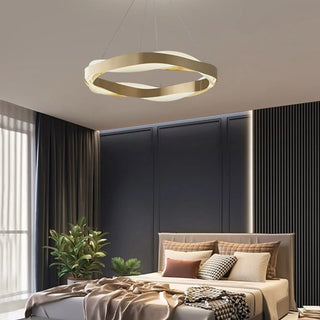
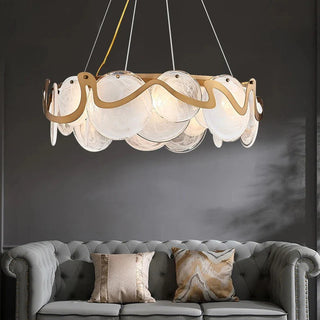

Minimalist lighting gets treated as a single look, usually a black or white geometric fixture on a bare wall. That is one version of it, but minimalism is really a principle, not a style: strip a fixture down to the shapes and materials that actually do work, and cut everything else. That principle can show up in a linear chandelier, a marble table lamp, or a plain glass pendant. The common thread is restraint, not any one finish.
Already know what you are shopping for? See our minimalist lighting collection in linear, rectangular, drum, and glass-cube designs.
What actually counts as minimalist lighting?
The collection spans minimalist chandeliers in linear, rectangular, drum, and glass-cube designs, pendant lights, marble and metal wall lamps, and sleek floor and table lamps, all with clean lines suited to modern interiors. What unites them is the absence of ornamentation rather than any single material or color: no crystal drops, no carved detail, no visual noise beyond the shape doing its job.
| Trait | What defines it |
|---|---|
| Form | Clean geometric shapes: linear bars, rectangles, drums, cubes |
| Ornamentation | None beyond the base shape and material |
| Materials | Aluminum, stainless steel, marble, travertine, glass, crystal |
| Accents | Black, gold, or copper used sparingly, not throughout |
What materials are used in minimalist fixtures?
Popular materials include aluminum, stainless steel, natural marble and travertine, glass and crystal, with black, gold, and copper accents. Most fixtures feature energy-efficient integrated LED light sources, which suits the style's preference for a clean, uninterrupted silhouette over a visible traditional bulb.
Ready to browse? See minimalist lighting in pendant, wall, floor, and table styles.
Where does minimalist lighting work best?
Different fixture types suit different rooms within the same overall principle.
- Minimalist pendant lights for kitchens and dining areas, where a clean line over an island reads as intentional rather than sparse.
- Streamlined wall sconces for subtle accent lighting, doing quiet work rather than acting as a focal point.
- Modern floor lamps for minimalist living rooms, providing ambient light without competing with furniture.
- Ceiling fixtures with a minimalist aesthetic, often a single geometric shape rather than a cluster of smaller lights.
How is minimalist different from Nordic or modern?
Minimalism is a principle that can apply inside other styles, which is why it gets confused with them. Nordic lighting is a specific Scandinavian tradition that pairs minimalist form with natural materials and warmth, wood, marble, soft glass. Modern lighting, in the everyday sense, is more about practical three-layer illumination than any particular look. A fixture can be minimalist and Nordic at once, or minimalist and industrial, since minimalism describes how much ornamentation a piece carries, not which era or geography it comes from. For the Scandinavian version specifically, see our Nordic lighting guide.
What mistakes make minimalist lighting feel cold instead of clean?
A few habits push a minimalist room from "considered" into "unfinished."
- Choosing only cool white bulbs, which strips warmth from an already stripped-down room.
- Using exclusively hard, reflective materials, glass and polished metal, with nothing soft or matte to balance them.
- Removing so much that the room reads as empty rather than restrained.
- Mixing too many accent colors, black, gold, and copper all in the same room undercuts the discipline the style depends on.
Building your minimalist lighting plan step by step
Work through it in this order.
- Pick one core shape language, linear, rectangular, drum, or cube, and repeat it across the room's fixtures.
- Choose one or two materials at most: a metal and a stone, or a metal and glass.
- Limit accent color to one choice, black, gold, or copper, not all three.
- Use warm white bulbs to avoid a sterile feel, unless the room is deliberately cool and industrial.
- Leave enough furniture and texture in the room that the minimalism reads as a choice, not an empty space.
Not sure which fixtures fit your room? Reach out to our team and we will help you plan it out.
Ready to shop the full range? Browse minimalist lighting in linear, rectangular, drum, and glass-cube designs.
About the author
Konstantin Khanasiuk is the founder of Mirodemi and works with luxury lighting day to day, helping homeowners and designers apply minimalist principles without tipping a room into feeling cold or unfinished.
Frequently asked questions
What types of minimalist lighting does Mirodemi offer?
The collection spans minimalist chandeliers in linear, rectangular, drum, and glass-cube designs, pendant lights, marble and metal wall lamps, and sleek floor and table lamps, all with clean lines suited to modern interiors.
What materials are used in minimalist light fixtures?
Popular materials include aluminum, stainless steel, natural marble and travertine, glass, and crystal, with black, gold, and copper accents. Most fixtures feature energy-efficient integrated LED light sources.
Is minimalist lighting the same as Nordic lighting?
Not exactly. Minimalism is a principle about restraint in form and ornamentation that can apply across many styles. Nordic lighting is a specific Scandinavian tradition that pairs that restraint with natural materials and warm light.
Does minimalist lighting feel cold?
It can, if every fixture uses cool white bulbs and hard reflective materials with nothing to soften them. Warm bulb temperature and at least one softer material, wood, marble, or fabric, keep a minimalist room from feeling sterile.
Sources
Mirodemi minimalist lighting collection page: material and design descriptions, collection FAQ Interior design references: minimalism as a cross-style design principle versus a fixed aesthetic
Not sure which fixture fits your space?
Send room size, ceiling height and a photo. Our team will suggest sizes and models that fit your project.
Not sure which fixture fits your space?
Send room size, ceiling height and a photo. Our team will suggest sizes and models that fit your project.