



Kitchen lighting has to work harder than almost any other room in the house. It needs to be bright enough for chopping vegetables, warm enough for a late dinner at the island, and stylish enough to anchor the busiest room in the home, often all within the same fixture. Get the numbers wrong and you end up with a beautiful pendant that leaves the counter in shadow, or task lighting so harsh it kills the mood the moment dinner is served. Here are the exact figures for getting it right.
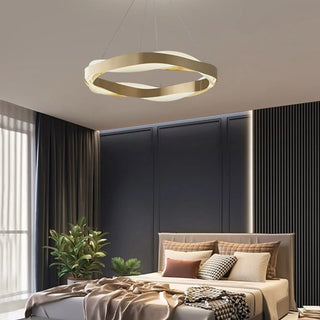
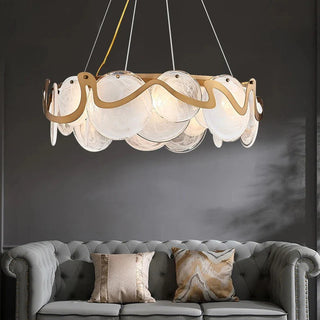
Already know what you are shopping for? See our kitchen light fixtures collection in minimalist LED, wave-shaped chandelier, and pendant styles.
How many pendant lights do I need over my kitchen island?
Plan on two pendants for a standard 4 to 6 foot island, and three to four pendants for islands 7 feet or longer. Space them about 28 to 30 inches apart and hang them 30 to 36 inches above the countertop.
| Island length | Pendant count | Spacing |
|---|---|---|
| 4 to 6 feet | 2 pendants | 28 to 30 inches apart |
| 7 feet or longer | 3 to 4 pendants | 28 to 30 inches apart |
For an exact layout based on your island's dimensions, use our kitchen island pendant calculator.
Can I hang a pendant over the sink?
Yes. A single pendant hung 30 to 36 inches above the sink, or a pair spaced about 24 inches apart, is the standard solution. Center the fixture on the sink basin itself, not on the window above it, since those two points rarely line up.
If the sink sits under a window, keep the fixture diameter under roughly 12 inches so it does not block the view. Directly over a sink, choose a damp-rated fixture with a glass or metal shade you can wipe clean, since fabric shades collect grease and steam over time. Full wet rating is only required outdoors or inside a shower enclosure, so a damp rating is enough here.
Ready to browse? See kitchen light fixtures in gold, black, and chrome finishes.
How high should a fixture hang over a kitchen table?
Hang the bottom of a chandelier or pendant 30 to 36 inches above the tabletop with a standard 8-foot ceiling, and add about 3 inches for every additional foot of ceiling height, which works out to 36 to 40 inches at a 10-foot ceiling.
For diameter, take the table width and subtract 12 inches: a 42-inch round table suits a 28 to 30-inch fixture. Over a rectangular table, use a linear pendant about two thirds of the table length. Center the fixture on the table itself rather than on the room, since kitchen tables are rarely centered in the space.
How bright should kitchen lighting be?
Plan on 30 to 40 lumens per square foot in a kitchen, roughly double what a living room needs. A 200 square foot kitchen therefore wants 6,000 to 8,000 lumens in total, split across layers.
| Layer | Lumens |
|---|---|
| Ambient light from ceiling fixtures | 3,000 to 4,000 lumens total |
| Island pendant | 300 to 400 lumens per pendant |
| Under-cabinet strip | 200 to 300 lumens per linear foot |
Never rely on a single central fixture, since it throws your own shadow onto the worktop while you are cooking. Put each layer on its own dimmer so you can drop to 20 to 30 percent output in the evening once prep work is done.
What color temperature and CRI should kitchen lights be?
Use 2700K to 3000K warm white for island pendants and any fixture visible from the dining or living area, since it keeps wood, brass, and warm stone looking rich rather than washed out. For under-cabinet and prep task lighting, 3000K to 3500K gives crisper visibility, and it is worth staying below 4000K in a residential kitchen to avoid a clinical feel.
Choose LEDs with a CRI of 90 or higher so food colors read accurately, since fresh produce and raw meat look grey and unappetizing under CRI 80 lamps. Keep every fixture in the room within 500K of the others, since mixed color temperatures are the most common reason a newly lit kitchen looks off even when every individual fixture looks fine on its own.
Building your kitchen lighting plan step by step
Work through it in this order.
- Count island pendants based on length: two for 4 to 6 feet, three to four for 7 feet or longer.
- Set pendant spacing at 28 to 30 inches and mounting height at 30 to 36 inches above the counter.
- Plan sink lighting separately, one pendant or a spaced pair, damp-rated if it sits directly over the basin.
- Calculate total lumens at 30 to 40 per square foot, split across ambient, pendant, and under-cabinet layers.
- Standardize color temperature across all fixtures, warm white for visible areas, slightly cooler for task zones, always CRI 90 or higher.
- Put each lighting layer on its own dimmer.
For general chandelier sizing on other fixtures in the home, see our chandelier size guide.
Not sure how many fixtures your kitchen needs? Reach out to our team with your layout and we will help you plan it.
Ready to shop the full range? Browse kitchen light fixtures in minimalist LED, wave-shaped chandelier, and pendant styles.
About the author
Konstantin Khanasiuk is the founder of Mirodemi and works with luxury lighting day to day, helping homeowners and designers get kitchen pendant count, height, and brightness right before the fixtures go up rather than after.
Frequently asked questions
How many pendant lights should I hang over my kitchen island?
Two pendants for a standard 4 to 6 foot island, three to four for islands 7 feet or longer, spaced about 28 to 30 inches apart.
How high should kitchen pendants hang above the counter?
30 to 36 inches above the countertop, and the same range applies over a sink. Over a table, add roughly 3 inches per extra foot of ceiling height beyond 8 feet.
How bright should kitchen lighting be?
Around 30 to 40 lumens per square foot in total, roughly double a living room's needs, split across ambient ceiling light, island pendants, and under-cabinet task lighting.
What color temperature is best for kitchen lights?
2700K to 3000K warm white for pendants and visible fixtures, 3000K to 3500K for under-cabinet task lighting, always with a CRI of 90 or higher so food colors read accurately.
Sources
Mirodemi kitchen light fixtures collection page: pendant count, spacing, mounting height, lumens, and color temperature guidance Lighting design references: lumens per square foot and CRI conventions for residential kitchens
Not sure how many pendants your island needs?
Share your island length and ceiling height. We will suggest pendant size, count and spacing with matching models.
Not sure how many pendants your island needs?
Share your island length and ceiling height. We will suggest pendant size, count and spacing with matching models.