


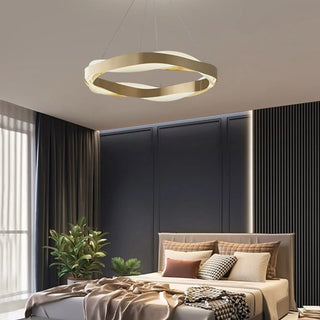
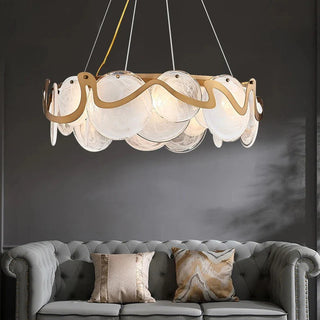

A single Art Deco chandelier can carry an entire room, which is exactly why it is the style people most often get wrong. Buy one statement fixture and stop there and the room feels curated. Buy the fixture, the matching sconces, and the matching table lamp, and the same room starts to feel like a hotel lobby. I treat Art Deco as an accent language, not a full vocabulary: one bold geometric piece per room, let it lead, and keep everything else quiet around it.
Already know what you're shopping for? Here are the Art Deco lighting fixtures in brass, chrome, and crystal, from statement chandeliers to table lamps.
What actually makes a fixture read as Art Deco?
Three things separate Art Deco from every other vintage-adjacent style, and a fixture usually needs at least two of them to read correctly rather than as generic "gold and glass."
| Trait | What to look for |
|---|---|
| Geometric symmetry | Stepped tiers, fan or sunburst shapes, repeating angular lines rather than curves |
| Luxe materials | Polished brass, chrome, or nickel paired with cut crystal or faceted glass |
| Bold scale | Fixtures sized to be a focal point, not a background fill light |
The style traces back to the 1920s and 1930s, and that origin shows up in the details: symmetry over asymmetry, hard edges over organic curves, and metal finishes polished enough to catch light rather than left matte. A fixture with soft curves and a brushed finish might be beautiful, but it is reading as something else, not Art Deco.
Which rooms carry an Art Deco fixture best?
Art Deco wants a room with enough visual quiet to actually notice it. A dining room or foyer, both of which have one obvious ceiling focal point and comparatively little else competing for attention, are the two rooms where the style earns its keep with the least effort.
- Dining room: a stepped or fan-shaped chandelier centered over the table reads as intentional glamour rather than costume.
- Foyer or entry: the first fixture guests see sets the tone for the house, and Art Deco makes an entrance without needing a second piece to back it up.
- Primary bedroom: a single Art Deco table lamp on one nightstand, not both, keeps the geometry from feeling like a matched set.
- Living room: works best as a wall sconce pair flanking a mirror or fireplace, rather than the main ceiling fixture, if the room already has a strong modern sofa or rug.
A kitchen or a busy family room, where the eye already has plenty to land on, is where Art Deco tends to get lost or read as clutter instead of glamour.
Ready to see fixtures built for that focal-point role? Browse Art Deco lighting in chandeliers, sconces, pendants, and table lamps.
How do I mix Art Deco into a room that is not Art Deco?
Almost nobody actually decorates a full Art Deco house today, and that's fine. The style works best as one loud piece in an otherwise calm, contemporary room.
- Pick one fixture type to carry the style, ceiling or table lamp, not both in the same room.
- Repeat only the metal finish elsewhere in the room, on door hardware or a mirror frame, not the geometric pattern itself.
- Keep the furniture underneath it simple. A stepped brass chandelier over an ornate carved table competes with itself; the same chandelier over a plain wood table has room to be the star.
- If you already own crystal or cut-glass decor, let the fixture pick up that material rather than introducing a third texture.
What mistakes make Art Deco lighting look like a costume instead of a style?
The same handful of mistakes turn Art Deco from elegant into theme-party territory.
- Matching the chandelier, sconces, and table lamp in the same room, which reads as a showroom set rather than a considered choice.
- Mixing warm brass with cool chrome in fixtures that sit in the same sightline, which fights against the polished, unified metal look the style depends on.
- Pairing a bold geometric fixture with equally bold patterned furniture underneath it, leaving the eye nowhere to rest.
- Using a dim or overly warm bulb that hides the faceted crystal or glass detailing the fixture was bought for in the first place.
Building your Art Deco lighting plan step by step
Plan Art Deco lighting in this order: choose the anchor fixture and room first, then let everything else stay deliberately plain.
- Pick one room with a clear single focal point, dining room, foyer, or one side of a bedroom.
- Choose either a ceiling fixture or a table lamp for that room, not both.
- Match the metal finish, brass, chrome, or nickel, to one other hardware element already in the room.
- Keep furniture and textiles in that sightline simple and unpatterned.
- Use a clear or lightly frosted bulb bright enough to show the crystal or glass faceting rather than diffusing it.
Not sure which piece works for your room's proportions? Reach out to our team with a photo of the space and we'll help you find the right scale.
For general chandelier sizing once you've picked a fixture, see our chandelier size guide.
Ready to shop the full range? Browse Art Deco lighting fixtures in brass, chrome, and crystal.
About the author
Konstantin Khanasiuk is the founder of Mirodemi and works with luxury lighting day to day, helping homeowners and designers choose fixtures that carry a room without overwhelming it. He writes from hands-on experience sourcing and shipping statement pieces for real interiors, not showroom mockups.
Frequently asked questions
What makes a light fixture Art Deco?
Geometric symmetry such as stepped tiers or sunburst shapes, luxe materials like polished brass or chrome paired with crystal or faceted glass, and a bold scale meant to be a focal point rather than background light.
Where should I put an Art Deco chandelier?
A dining room or foyer works best, since both rooms have one clear ceiling focal point and less competing detail than a living room or kitchen.
Can I mix Art Deco with modern furniture?
Yes, and it usually looks better that way. Pick one Art Deco fixture as the room's statement piece, keep the furniture underneath it simple, and repeat only the metal finish elsewhere rather than the geometric pattern.
Is Art Deco lighting too much for a small room?
Not if you use one piece. A single Art Deco table lamp or a pair of sconces reads as a deliberate accent in a small room; a full ceiling fixture plus sconces plus a lamp reads as costume, regardless of room size.
Sources
Design history references: Art Deco period characteristics (1920s-1930s), geometric ornamentation and material use Interior design guidance: layering statement vintage fixtures into contemporary rooms
Not sure which fixture fits your space?
Send room size, ceiling height and a photo. Our team will suggest sizes and models that fit your project.
Not sure which fixture fits your space?
Send room size, ceiling height and a photo. Our team will suggest sizes and models that fit your project.