


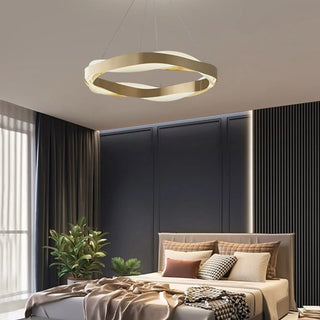
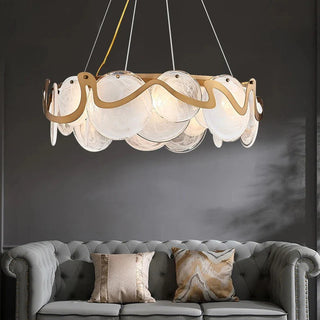

Wall sconces do two jobs at once: they wash a room in soft, layered light, and they act as sculpture on an otherwise empty wall. The most common mistake is treating every sconce the same, hanging a bedside pair at the same height as a hallway run. The right height and spacing depends entirely on what the sconce sits next to. Here are the numbers for each situation.
Looking for fixtures to try these numbers on? See our wall sconces collection in brass, crystal, marble, and matte black finishes.
How high should I mount a wall sconce?
As a starting point, mount the center of most sconces 60 to 70 inches from the floor. That is a general rule, not a fixed number, since the object beside the sconce changes it.
| Location | Mounting height |
|---|---|
| General wall sconce (no nearby object) | 60 to 70 inches from floor to center |
| Flanking a mirror | Eye level, roughly matching the mirror's midpoint |
| Beside a bed | 20 to 24 inches above the mattress top |
| Hallway run | 60 to 66 inches, consistent along the corridor |
Go a little lower at the bedside than the general rule suggests. A sconce mounted at 65 inches over a low nightstand ends up too far from the page you are trying to read.
How far apart should a pair of sconces be?
For a flanking pair beside a bed, mirror, or fireplace, space them roughly the width of the object plus 12 to 24 inches on each side. A 60-inch headboard, for example, works with sconces set about 72 to 84 inches apart center to center.
For a hallway or corridor run, space individual fixtures every 6 to 8 feet. Closer than that and the wall starts to feel busy; farther apart and you get uneven pools of light with dark gaps between them.
Not sure what your exact spacing should be? Use our wall sconce placement guide and calculator for numbers based on your own room measurements.
How bright should a wall sconce be?
Brightness needs depend on whether the sconce is doing ambient work or task work.
| Use | Lumens per sconce |
|---|---|
| Ambient or decorative wall wash | 400 to 800 lumens |
| Reading in bed | 600 to 900 lumens, directed downward |
A sconce meant purely to lift a wall and add warmth does not need to compete with the room's main ceiling fixture, so stay on the lower end of that range. A reading sconce needs more output and ideally sits on an adjustable or swing-arm body, so you can aim the light at the page instead of at whoever is sleeping next to you. Stay at 2700K to 3000K warm white in living rooms and bedrooms, and put pairs of sconces on a dimmer for the most flexible result.
What size sconce should I choose?
Scale the fixture to whatever it sits beside. Flanking a mirror or headboard, the sconce should be about one quarter to one third of that object's height, which puts most sconces between 10 and 16 inches tall.
Projection off the wall matters just as much as height. In a hallway or beside a door, keep the fixture within 4 to 5 inches of the wall so nobody catches a shoulder on it walking past. A living room wall with more clearance can carry a fixture with 6 to 8 inches of projection without becoming a hazard.
Are wall sconces hardwired or plug-in?
Most wall sconces are hardwired and mount to a standard wall junction box, which gives the cleanest look and lets you switch them from the wall like any other fixture. If you want sconces where no junction box exists, an electrician can usually run a spur, or you can choose a plug-in model and route the cord through a discreet cover.
Selected designs run cordless and rechargeable instead, mounting with a bracket or adhesive plate and running 6 to 20 hours per charge. These work well in rented homes or on masonry walls where running new wiring is not practical.
Building your wall sconce plan step by step
Work through it in this order.
- Decide what the sconce sits beside: a mirror, a bed, a mantel, or a bare hallway wall.
- Set mounting height based on that object, using the eye-level, bedside, or general 60-70 inch rule.
- Space a flanking pair using the object's width plus 12 to 24 inches, or space a hallway run every 6 to 8 feet.
- Match brightness to the sconce's job: 400 to 800 lumens for ambient wash, 600 to 900 for reading.
- Confirm the fixture's projection fits the space, tighter in hallways, looser on open walls.
For general chandelier sizing on other fixtures in the room, see our chandelier size guide.
Not sure which sconce fits your wall? Reach out to our team with your measurements and we will help you plan it out.
Ready to shop the full range? Browse wall sconces in brass, crystal, marble, and matte black finishes.
About the author
Konstantin Khanasiuk is the founder of Mirodemi and works with luxury lighting day to day, helping homeowners and designers get wall sconce height and spacing right the first time instead of patching extra holes later.
Frequently asked questions
How high should a wall sconce be mounted?
As a general rule, 60 to 70 inches from the floor to the center of the fixture. Go lower beside a bed, at roughly 20 to 24 inches above the mattress top, and match eye level when flanking a mirror.
How far apart should two wall sconces be?
For a flanking pair, space them the width of the object between them, a headboard or mirror, plus 12 to 24 inches. For a hallway run, space individual fixtures every 6 to 8 feet.
How many lumens should a wall sconce put out?
400 to 800 lumens for ambient or decorative use, and 600 to 900 lumens directed downward for a reading sconce beside a bed.
Are wall sconces hard to install?
Most are hardwired to a standard junction box, which a licensed electrician handles in under an hour if the wiring already exists. Cordless, battery-powered options are also available and mount with a bracket or adhesive plate, no wiring required.
Sources
Mirodemi wall sconces collection page: mounting height, spacing, brightness, size, and projection guidance Lighting design references: ambient versus task lumens and color temperature conventions for residential wall fixtures
Placing wall sconces?
Send the wall dimensions and a photo. We will suggest size, height and spacing with matching models.
Placing wall sconces?
Send the wall dimensions and a photo. We will suggest size, height and spacing with matching models.