



Quick answer: Textured glass has a deliberately uneven, rippled, or pressed surface rather than a smooth one, which breaks light into a layered, dappled glow instead of a single clean beam. It suits dining rooms, living rooms, and bedrooms, and a textured glass chandelier typically costs $800–$2,500 depending on scale.
Textured versus frosted versus clear
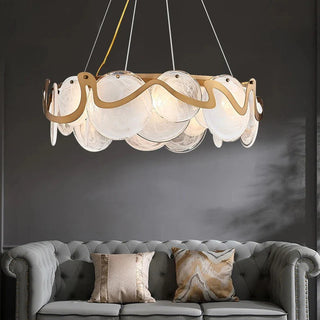
These three finishes solve different problems. Clear glass shows the bulb directly and lets light scatter and refract sharply. Frosted or obscure glass treats the surface so it's translucent rather than transparent, diffusing light into an even, cloud-like glow with no visible bulb points. Textured glass takes a middle path: the surface is pressed, ribbed, or rippled rather than smoothed flat, so light passing through breaks into a layered, uneven pattern that changes with viewing angle — more visual movement than frosted glass, but without showing the bulb directly the way clear glass does.
Mirodemi offers two versions of the look. The Vespera pairs textured glass shades with an electroplated brass-toned frame in two sizes, six or nine lights, mounted on interchangeable rods for a fixed drop over a table. The Caspian scales further, from six to eighteen lights across four sizes, hung on an adjustable chain rather than a rod, which makes it more flexible for varying ceiling heights.
Rod-mounted or chain-hung: what it means for installation
Vespera's rod mount holds the fixture rigid at a fixed drop, which keeps a wide fixture level and stable over a table — useful when the chandelier's width makes it prone to swinging on a chain. Caspian's chain mount trades that rigidity for adjustability, letting the drop extend further in a room with higher ceilings or a two-story stairwell, at the cost of the shade having slightly more sway than a rod-mounted piece.
What to check before ordering
- Bulbs are not included on either design. Vespera and Caspian both take E14 bulbs purchased separately — factor that into your budget and pick a consistent color temperature across however many sockets your size requires.
- Size scales with light count, not just diameter. Caspian's four sizes run from six to eighteen lights — check that the bulb count matches the brightness you actually want, not just the physical footprint.
- Rod versus chain affects ceiling height flexibility. If your ceiling height is non-standard or you're unsure of the exact drop needed, Caspian's chain offers more room to adjust after installation than Vespera's fixed rod.
FAQ
Does textured glass hide the bulb like frosted glass does?
Not completely — textured glass breaks up the light more than clear glass but is less opaque than true frosted or obscure glass, so there is some visible brightness at the bulb points depending on the specific texture and bulb wattage.
Which is easier to clean, textured or smooth glass?
Textured surfaces can hold slightly more dust in their ridges than smooth glass, so a soft brush attachment works better than a flat cloth for routine cleaning.
Can I mix rod and chain mounting on the same fixture?
No — each design ships with one mounting method as specified (Vespera rod-only, Caspian chain-only), so choose based on which suits your ceiling and desired drop before ordering.
Not sure which fixture fits your space?
Send room size, ceiling height and a photo. Our team will suggest sizes and models that fit your project.
Not sure which fixture fits your space?
Send room size, ceiling height and a photo. Our team will suggest sizes and models that fit your project.