


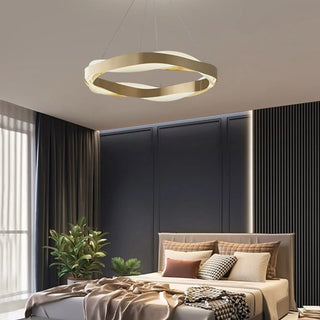
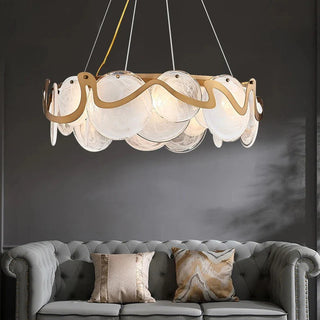

Most people shopping for "modern lighting" are not trying to recreate a design-history period. They want a room that looks clean and current and is actually well lit for daily use. The mistake I see most often is buying one nice ceiling fixture and stopping there. Good modern lighting is layered: three distinct light sources doing three different jobs. Here is how to build that layering, room by room.
Ready to shop the collection? See modern lighting fixtures in chandelier, pendant, sconce, and lamp styles.
What are the three light layers every room needs?
Lighting designers talk about three layers, and skipping any one of them is why a room can look expensive and still feel flat or harsh.
| Layer | Purpose | Typical fixture |
|---|---|---|
| General light | Even, overall illumination for the room | Chandelier, flush mount, or pendant |
| Ambient fill | Softer secondary light that removes hard shadows | Wall sconces, floor lamps |
| Task light | Focused light for a specific activity | Table lamps, under-cabinet or desk lighting |
A room with only a ceiling fixture and nothing else tends to throw hard shadows and feel clinical at night. Adding even one sconce or floor lamp changes that immediately.
How do I apply the three layers in each room?
Different rooms need the layers in different proportions, and matching the mix to how the room is actually used matters more than matching a style photo.
- Living room: a chandelier or pendant for general light, a floor lamp beside seating for ambient fill, and a table lamp for reading.
- Kitchen: pendant lights over the island for general light, under-cabinet task lighting for prep areas.
- Bedroom: a flush mount or small chandelier for general light, wall sconces flanking the bed for reading without a bedside lamp taking up nightstand space.
- Dining room: a single chandelier or linear pendant sized to the table, since dining rooms usually need less layering than living spaces.
Browse modern lighting across chandeliers, pendants, sconces, and lamps for every room.
How do I keep a layered scheme from looking mismatched?
Layering adds fixtures, and more fixtures means more chances for the room to feel scattered instead of coordinated.
- Pick one finish, black, gold, or chrome, and repeat it across every fixture in the room.
- Keep shade or shape language consistent. If your chandelier is glass and geometric, your sconces should not be fabric and rounded.
- Match bulb color temperature across all three layers. Mixing warm and cool bulbs in the same room is the fastest way to make a coordinated fixture set look off.
- Add fixtures gradually and step back after each one. Layering is additive, and it is easier to notice when a room has too much going on than to plan it perfectly upfront.
What mistakes keep modern rooms from feeling finished?
A few habits show up again and again when a "modern" room does not quite land.
- Stopping at one ceiling fixture and calling it done, which leaves the room under-lit at night despite looking fine in daylight.
- Buying fixtures one at a time with no finish plan, ending up with three different metals in one room.
- Undersizing the main ceiling fixture for the room or table below it.
- Skipping dimmers, which limits a modern room to one lighting mood instead of shifting from daytime bright to evening ambient.
Building your modern lighting plan step by step
Work through it in this order.
- Identify your general light source for the room: chandelier, pendant, or flush mount.
- Add one ambient layer: wall sconces or a floor lamp.
- Add task lighting where the room needs it: table lamps, under-cabinet lights, or a desk lamp.
- Choose one finish and repeat it across every fixture.
- Match bulb color temperature across all layers, and add dimmers where possible.
For general chandelier sizing, see our chandelier size guide.
Not sure how to layer your space? Reach out to our team and we'll help you plan it room by room.
Ready to shop the full range? Browse modern lighting fixtures in LED, glass, metal, and crystal designs.
About the author
Konstantin Khanasiuk is the founder of Mirodemi and works with luxury lighting day to day, helping homeowners and designers build layered lighting plans that hold up for everyday use, not just how a room photographs in daylight.
Frequently asked questions
What is the difference between general, ambient, and task lighting?
General light evenly illuminates the whole room, usually from a ceiling fixture. Ambient fill softens shadows from a secondary source like a sconce or floor lamp. Task lighting focuses on a specific activity, like reading or food prep.
Do I need all three light layers in every room?
Most rooms benefit from at least two layers. Dining rooms often work fine with just a well-sized chandelier or pendant, since the activity there is more uniform than in a living room or kitchen.
How many finishes should I mix in a modern room?
One, occasionally two if they are closely related, like brushed and polished versions of the same metal. Three or more distinct finishes in one room tends to read as unplanned.
Are dimmers worth adding to a modern lighting plan?
Yes. A layered scheme without dimmers still only gives you one lighting mood. Dimmers let the same fixtures shift from bright daytime light to a softer evening feel.
Sources
Lighting design guidance: general, ambient, and task lighting layering principles Interior design references: finish coordination and color-temperature matching in residential lighting
Not sure which fixture fits your space?
Send room size, ceiling height and a photo. Our team will suggest sizes and models that fit your project.
Not sure which fixture fits your space?
Send room size, ceiling height and a photo. Our team will suggest sizes and models that fit your project.