


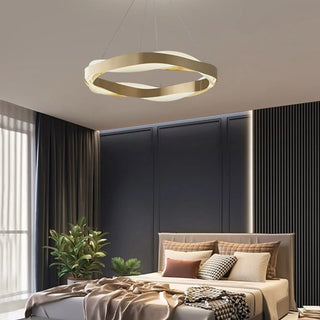
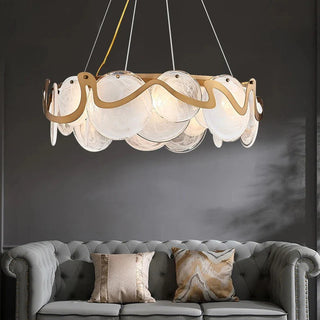


Quick answer: what makes a chandelier luxury?
Three things: the light-carrying material, the frame and finish underneath it, and the engineering that lets the piece scale. Hand-cut crystal, natural alabaster and hand-blown Murano-style glass cost more than pressed acrylic because each piece is cut, cast or blown individually. A solid brass or powder-coated steel frame costs more than plated pot metal because it holds finish and alignment for decades. In our catalogue that translates to roughly $573 for a small artisan-glass fixture and up to $10,721 for a large multi-ring alabaster piece.
What are you actually paying for?
Strip away the marketing and the price of a chandelier comes down to four measurable things.
- Material volume. A cascading crystal fixture at 100 cm diameter carries several times the crystal of a 50 cm version. That is why the same design can span $1,418 to $5,931 across its size range.
- Cut and finish quality. Machine-pressed glass has visible mould seams and scatters light flatly. Hand-cut K9 crystal has clean facet edges and throws defined light.
- Frame construction. Solid brass and steel hold their geometry; thin plated alloy sags at the arm joints over time and shows finish wear at contact points.
- Light engineering. Integrated LED with a genuine dimming driver and a specified colour temperature costs more than a socket plate with a bulb in it.
How do crystal, alabaster and Murano glass compare?
| Material | How it handles light | Typical price range | Best suited to | Maintenance |
|---|---|---|---|---|
| Cut crystal (K9) | Refracts into sharp points of light; high sparkle | $855-8,615 | Staircases, foyers, formal dining | Periodic dusting; cleaning without disassembly is possible |
| Natural alabaster | Glows from within; soft, diffused, no glare | $894-10,721 | Dining rooms, bedrooms, calm modern interiors | Dry dust only; stone is porous |
| Murano-style blown glass | Colour and depth in the glass itself; moderate sparkle | $573-3,074 | Living and dining rooms wanting colour | Soft cloth; each piece is individually blown |
| Metal and LED, no diffuser stone | Directional, architectural, crisp | $1,013-3,789 | Contemporary rooms, high ceilings | Lowest; wipe the frame |
Ranges are live catalogue prices across the full size run of each material family.
What do luxury chandeliers cost, tier by tier?
| Tier | Price | What changes at this level | Live examples |
|---|---|---|---|
| Entry | $550-1,200 | Real materials at smaller scale; fewer size and finish options | Virella tiered Murano glass from $573; La Neuveville gold crystal drum from $855 |
| Mid | $1,200-2,500 | Full size ranges, dimming options, multi-tier crystal | Zambrone round crystal from $1,187; Calyra Murano glass $1,288-1,558; Art Deco black and gold crystal from $1,461 |
| Upper | $2,500-5,000 | Architectural scale, heavier frames, statement geometry | Zelbio postmodern $2,126-3,789; Altavilla rectangular Murano $2,306-3,074; Sellara alabaster oval from $3,488 |
| Statement | $5,000+ | Double-height pieces and large multi-ring designs made to order | Capri large crystal up to $8,615; Spanish alabaster ring chandelier up to $10,721 |
How do you size a luxury chandelier for the room?
The two rules below cover almost every residential case, and they disagree with each other less often than people expect.
For a room: add the room's length and width in feet and read the total as inches of fixture diameter. A 14 ft x 16 ft living room wants roughly a 30 inch fixture, which is close to the Dia 80 cm option most large designs offer.
For a table: ignore the room and size to the table. Aim for a fixture between one half and two thirds of the table's width, or simply the table width minus 12 inches. A 48 inch round table takes a 24 to 32 inch fixture. A long rectangular table is better served by a linear or rectangular piece such as the Altavilla rectangular Murano glass chandelier at 90 cm or 120 cm.
For a double-height space: scale by height rather than floor area. Allow roughly 2.5 to 3 inches of fixture height for every foot of ceiling. A 20 ft foyer therefore wants a fixture 50 to 60 inches tall, which is where cascading designs like the gold cascading crystal staircase chandelier ($1,418-5,931, up to 350 cm tall) exist.
How high should it hang?
Over a dining table, the bottom of the fixture belongs 30 to 36 inches above the tabletop on a standard 8 ft ceiling, adding about 3 inches for each additional foot of ceiling height. In open floor space the bottom of the fixture should clear 7 feet from the floor, and over a staircase it should be visible from both floors without ever coming within reach of the stair run.
For stairwells and foyers, measure from the highest point people will see the fixture from, not just from the ground floor. A piece sized only for the entry view often looks stranded from the landing.
Which rooms justify a statement fixture?
Spend where the fixture is seen from more than one position. Double-height foyers and staircases qualify because the piece is on show from two levels at once, which is why staircase pieces are built around tall cascading forms. Formal dining rooms qualify because guests sit under the fixture for hours. Primary bedrooms and living rooms usually reward a mid-tier piece more than a statement one, since the fixture competes with furniture rather than filling empty volume.
Rooms with 8 ft ceilings rarely justify a statement chandelier at all. The clearance maths simply will not allow the drop, and a well-made flush or semi-flush fixture serves better.
How do you check quality before you buy?
Five checks catch most problems while the item is still in the cart.
- Is the size given in both metric and inches, with a stated height? Vague dimensions usually mean vague manufacturing.
- Is colour temperature specified? Look for an explicit 3000K warm or 6000K cool option rather than "LED included".
- Is dimming a listed option? Retrofitting dimming to an integrated LED driver is often impossible.
- Is the frame material named? "Metal" is not a specification; brass, steel and chrome are.
- Does the design scale? A design offered in four or five real sizes, like the Capri large crystal chandelier ($2,289-8,615), is engineered rather than merely styled.
Where to browse by material
Start with the full modern luxury chandeliers for living and dining collection to see the range in one place. For sparkle and formal rooms, the luxury crystal chandeliers range concentrates the cut-crystal designs. For soft, glare-free light, alabaster chandeliers and lighting covers the natural-stone pieces, while Murano glass chandeliers and wall sconces holds the hand-blown coloured glass.
FAQ: buying a luxury chandelier
How much should a good chandelier cost?
For a genuine material and a frame that lasts, expect to start around $850 to $1,200 for a mid-size piece. Below roughly $500 you are usually buying plated alloy and pressed acrylic. Large double-height fixtures run from about $2,300 into five figures because material volume and engineering both scale with size.
Is crystal or alabaster better for a dining room?
Alabaster is generally the better dining choice because it glows rather than sparkles, which means no glare in the eyeline of seated guests. Crystal suits dining rooms used formally and lit at night, where refraction is the point. Both work; the deciding factor is whether you want sparkle or calm.
What size chandelier fits a two-storey foyer?
Size by ceiling height, not floor area. Allow 2.5 to 3 inches of fixture height per foot of ceiling, so an 18 to 20 ft foyer takes a fixture roughly 45 to 60 inches tall. Cascading crystal designs are made in exactly these proportions, up to 350 cm in the largest options.
Are LED chandeliers worth it?
Yes, when the LED is properly engineered. Integrated LED with a real dimming driver and a specified colour temperature gives even output and long life with no bulb changes at height, which matters on a staircase. Avoid fixtures that list LED without naming colour temperature or dimming support.
How do I clean a crystal chandelier?
Dust regularly with a dry microfibre cloth and clean without disassembly wherever possible, working from the top down. Alabaster should be dusted dry only, as the stone is porous and absorbs liquid cleaners. Always switch the fixture off and let it cool before touching any part of it.
About the author
Konstantin Khanasiuk leads the design team at Mirodemi, specifying chandeliers for residential and hospitality projects across the United States. He reviews fixture drawings, materials and mounting details before every project quote, and the sizing and quality checks in this guide are the ones his team uses in practice. If you are choosing between sizes or materials for a specific room, our design team will work through the measurements with you before you order.
Not sure which fixture fits your space?
Send room size, ceiling height and a photo. Our team will suggest sizes and models that fit your project.
Not sure which fixture fits your space?
Send room size, ceiling height and a photo. Our team will suggest sizes and models that fit your project.