


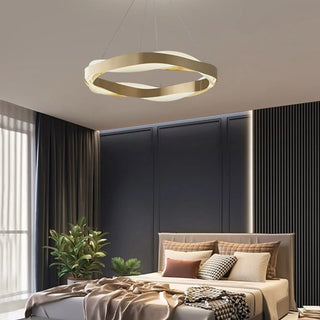
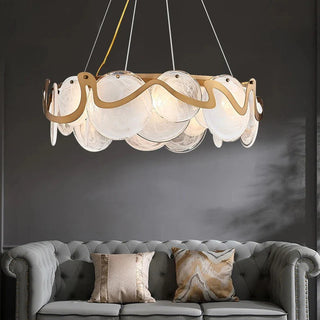

Quick answer: Wave design chandeliers bend a slim metal arm into one or more flowing curves and run a continuous LED light-guide along it, so the fixture reads as a single ribbon of light rather than a row of individual bulbs. They suit dining rooms, living rooms, and kitchen islands as a linear focal point, and a mid-size version typically costs $1,000–$1,500.
What defines the wave shape
Unlike a linear pendant, which runs a straight bar of light over a table, a wave chandelier curves that same idea into one or two soft bends — a double S-curve is common — so the fixture has visible motion even while stationary. The light itself usually comes from a seamless light-guide tube rather than exposed bulbs, which keeps the glow even along the whole curve instead of showing bright spots at each light source.
Mirodemi's Ondara Curved LED Wave Chandelier is a straightforward example: slim aluminum-alloy arms bent into a soft double wave carry a full-spectrum acrylic light-guide tube, offered in five lengths from about 39 to 79 inches and in black or gold. The related Carros is a similar minimalist wave-profile design aimed at dining rooms and open living spaces.
Where the look fits
- Dining rooms and kitchen islands, where the wave's length can run parallel to a table or island rather than centering as a single point of light.
- Living rooms, hung horizontally above a sofa or console as a linear accent rather than a traditional round or drum chandelier.
- Studies and open-plan spaces, where a sculptural but not overly ornate fixture suits a Nordic or minimalist palette.
Because the design reads as modern and linear, a wave chandelier is a mismatch for traditional or heavily ornate rooms — it works best in spaces already leaning toward clean lines and a neutral material palette.
Sizing and placement
Wave chandeliers are sized by length rather than diameter. For a dining table, choose a length roughly two-thirds to three-quarters of the table's length so the fixture doesn't overhang the ends; for a kitchen island, match it similarly to the island's length. Mount with the lowest point of the curve 30–36 inches above the table or counter surface, the standard clearance for dining and island fixtures.
What to check before ordering
- Finish. Black reads more contemporary and blends into darker ceilings; gold adds warmth and shows more as a standalone design statement — pick based on your existing metal hardware.
- Dimming. Wave chandeliers are frequently non-dimmable on the standard driver, though a dimmable driver may be available to order — confirm before purchase if adjustable brightness matters.
- Color temperature. Since the light comes from an integrated LED tube rather than replaceable bulbs, the color temperature (warm, neutral, or cool) is typically fixed at the time of order — choose carefully, as it can't be swapped later the way a bulb can.
FAQ
Is a wave chandelier the same as a linear pendant?
No. A linear pendant runs a straight bar of light, usually with individual bulbs or a straight light bar; a wave chandelier curves that same general format into one or more bends for a more sculptural silhouette.
Can a wave chandelier be mounted vertically instead of horizontally?
Most are designed for horizontal mounting over a table or island — check the specific fixture's hanging hardware before planning a vertical orientation, since not all models support it.
Does the integrated LED tube ever need replacing?
Integrated LEDs are rated for tens of thousands of hours and are not designed to be swapped like a standard bulb — if the light-guide tube eventually fails, expect to replace the fixture or contact the manufacturer about repair options rather than changing a bulb.