


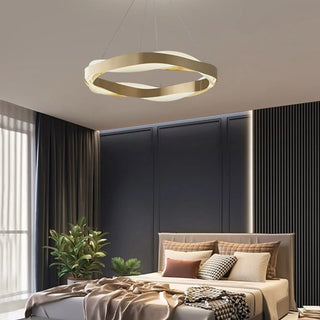
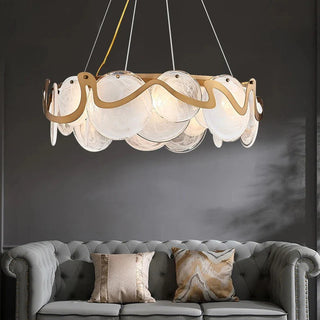

Quick answer: on a vaulted ceiling, hang the main fixture from the peak (or the room's visual center) using an adjustable-length suspension, and size its height to the peak: 2.5–3 inches of fixture per foot of ceiling height at the highest point. A 14-foot peak carries a fixture 35–42 inches tall. On a sloped section, use a sloped-ceiling canopy adapter and cord-hung — not rod-hung — fixtures so the light hangs plumb.
Where should the chandelier go under a vaulted ceiling?
Two correct answers: the geometric peak, if it sits over the room's main zone, or directly over the anchor furniture (dining table, seating group) even when that's off-peak. What never works is splitting the difference — a fixture floating between the peak and the table reads as a mistake from every seat. In great rooms, one statement fixture at the peak plus recessed or wall lighting at the edges is the classic layered answer.
How do you size a fixture for a tall vault?
Height drives the choice more than diameter. Take the ceiling height at the peak and allow 2.5–3 inches of fixture height per foot — then check that the lowest point still clears 7 feet over walking areas and 30–36 inches over a table. Tiered and cascading designs fill vertical space without excessive width: the Zurich tiered chandelier stacks 23.6 to 47.2-inch tiers into one tall composition, and long-drop pieces in our staircase chandelier collection — built for 14–20-foot stairwells — work identically under high vaults.
| Peak height | Fixture height | Format |
|---|---|---|
| 10–12 ft | 25–36 in | Single-tier chandelier or drum |
| 12–16 ft | 30–48 in | Two-tier or cascading |
| 16–20 ft | 40–70 in | Long-drop cascade (staircase-format) |
What hardware does a sloped ceiling need?
Three non-negotiables: a sloped-ceiling canopy (a hinged or angled mounting plate rated for your pitch — most standard canopies handle up to about 30 degrees), cord or chain suspension so gravity levels the fixture, and enough extra cord to reach your target hanging height measured from the floor, not the ceiling. Rigid-rod fixtures need a vault-specific adapter or they will hang visibly tilted — confirm before ordering, and ask us to check a specific fixture against your pitch.
How do you light the sloped sections themselves?
Don't fight the slope with more hanging fixtures — wash it. Uplight from wall sconces or cove strips turns the angled planes into a reflector that softens the whole room, and it flatters wood-clad vaults especially. Reserve pendants for level zones (islands, tables) and let the vault carry ambient light. For the statement piece itself, browse the full chandelier collection or living room lighting range — every listing shows exact fixture height so you can run the numbers above before buying.
The three most common vault mistakes
Buying a normal-room fixture that disappears under a 16-foot peak (run the height formula first), hanging the chandelier at standard 8-foot-room height so it blinds sightlines (measure clearance from the floor up, not the ceiling down), and skipping the dimmer — a vault fixture is visible from everywhere, and dimming is what lets it shift from working light to architecture after dark.
Do flush mounts or ceiling fans belong on a vault?
On the slopes themselves, no — both need level mounting. At the peak, a fan with a vault-rated downrod works in great rooms that need air movement, and wide semi-flush fixtures suit vaulted spaces whose peak is under about 11 feet; our flush mount chandeliers collection covers that low-peak case. Everywhere else under a vault, cord-hung fixtures with angled canopies remain the reliable answer.
How bright should a vaulted room be?
Vaulted volumes swallow light — plan 15–25 lumens per square foot of floor rather than the flat-ceiling 10–20, and split it across layers: the peak fixture for the center, sconces or cove uplight washing the slopes, and task fixtures over islands and reading zones. Dimmers on every layer let the room shift from bright and open by day to low and dramatic at night. In open-plan vaulted spaces, put each functional zone on its own circuit so the kitchen can work while the living area rests.
FAQ: vaulted ceiling lighting quick answers
How much extra cord should I order?
Measure from the mounting point to your target fixture height and add a safety margin — extra cord can be shortened at install, missing cord means reordering. Each listing states the fixture's maximum drop.
Can recessed lights go into a sloped ceiling?
Only sloped-rated ones with gimbal trims aimed straight down; standard cans throw their light at the opposite wall. Many vaulted rooms skip cans entirely in favor of uplight.
Do I need an electrician for a vault install?
For anything at a peak above standard ladder height, yes — staging or a lift plus a rated ceiling box is professional work, and it's the wrong place to economize.
What style suits a wood-clad vault?
Warm-metal and glass fixtures complement wood planks; black iron frames read strongest against white vaults. Uplight flatters wood grain more than downlight does.
About the author. Konstantin Khanasiuk leads lighting design at Mirodemi, helping homeowners and designers choose statement fixtures for kitchens, stairwells and foyers. Send us your peak height and pitch — we'll confirm fit before you order.
Not sure which fixture fits your space?
Send room size, ceiling height and a photo. Our team will suggest sizes and models that fit your project.
Not sure which fixture fits your space?
Send room size, ceiling height and a photo. Our team will suggest sizes and models that fit your project.