



Two pendants crowded into the center of a long island looks like an afterthought, and three spread edge to edge can leave the ends of the counter in shadow. I count, size and space every run of pendants off the length of the surface underneath, so the light lands evenly along the whole island or table instead of pooling in the middle. Here is how many linear pendants you need, what diameter each one should be, and how far apart to space them.
Already know what you're shopping for? Here are the linear pendant lights sized for islands, tables, and counters.
How many pendants does an island or table need?
Fixture count scales with the length of the surface, not with personal taste alone.
| Surface length | Recommended pendant count |
|---|---|
| Under 4 ft (small island or bar) | 2 pendants |
| 4 to 7 ft (standard island) | 2 to 3 pendants |
| 7 to 10 ft (large island or long table) | 3 to 4 pendants |
| Over 10 ft | 4 or more, spaced evenly |
A small island under 4 feet usually looks best with just 2 pendants centered over the workspace. Once the island stretches past 7 feet, adding a third or fourth fixture keeps the light even along the whole counter instead of concentrating it in the middle.
If you want a quick sanity check on the table above, plan on roughly one pendant per 24 to 30 inches of island or bar counter length, leaving equal space at each end so the fixtures frame the surface rather than crowd one side. A dining table works differently: a single statement fixture is the classic choice there, and I only reach for multiples once the table runs past about 7 to 8 feet. Most of the pendant lights for a kitchen island we ship are bought in pairs or threes for exactly this reason.
Pendant size and diameter: how wide should each fixture be?
Pendant size is the step most people skip, and it is the one that decides whether a correctly counted run still looks wrong. The rule I use is simple: the combined width of all the pendants over an island should equal about one third of the island's length. Add up the diameters, not the spacing. One large fixture carrying that job on its own typically lands somewhere in the 18 to 32 inch range, while a run of multiples usually looks most balanced at 10 to 16 inches per fixture.
| Setup | Pendant diameter |
|---|---|
| All pendants combined | About one third of the island length |
| Single pendant | 18 to 32 in |
| Multiple pendants | 10 to 16 in each |
Over a dining table the same one third rule applies to the table's length, which is the identical math you would use to size a dining room chandelier for that table. Undersized pendants read as scattered dots over a wide surface, and oversized ones swallow the island and crowd the sightline across the room.
How far apart should linear pendants be spaced?
Spacing determines whether the light reads as one continuous run or as scattered, uneven pools.
| Pendant count | Spacing between fixtures |
|---|---|
| 2 pendants | 24 to 30 in apart, center to center |
| 3 pendants | 20 to 26 in apart, center to center |
| 4 or more pendants | 18 to 24 in apart, center to center |
As pendant count goes up, spacing tightens slightly so the run still reads as evenly distributed across the full surface rather than clustering fixtures at one end. Keep the spacing consistent between each pendant rather than eyeballing gaps individually.
Ready to compare pendant counts and spacing? Browse linear pendant lights in single, paired, and multi-light styles.
How far from the edge should pendants be centered?
Offset from the edges of the island or table keeps the run looking centered and intentional rather than crowded to one side.
| Surface | Offset from each end |
|---|---|
| Island or counter | 12 to 18 in from each end |
| Dining or farmhouse table | 18 to 24 in from each end |
Centering the whole run with even offset on both ends keeps the pendants from reading as pushed toward one side of the island. For a table, leave more room on each end so the outermost pendant does not sit directly above where a chair pulls in.
How high should the run hang above the surface?
Hang the bottom of each pendant 30 to 36 inches above a dining table or kitchen counter, and 28 to 34 inches above a taller bar top. Ceiling-height adjustments, surface heights and the full drop math live in our pendant light drop height guide.
How bright should a pendant run be?
Island and counter pendants do double duty as task lighting, so they need more output than a purely decorative fixture. These are the total combined lumens I aim for across the whole run, not per fixture.
| Space | Recommended total lumens |
|---|---|
| Small island / breakfast bar (~15 sq ft) | 1,500 to 2,000 lm |
| Standard island (~24 sq ft) | 2,500 to 3,000 lm |
| Large island (~35 sq ft) | 3,500 to 4,500 lm |
| Dining table (~30 sq ft) | 2,500 to 3,500 lm |
| Bar counter (run of 6 to 8 ft) | 2,000 to 3,000 lm |
Warm white at 2700K to 3000K keeps kitchens and dining rooms inviting, and putting the run on a dimmer lets the same fixtures handle food prep and evening entertaining. If the pendants are sharing the room with other fixtures, count those into the total before you buy, the same way I balance output across a full dining room lighting scheme.
Which pendant style suits your space?
Once count, size and spacing are settled, style is what makes the run belong to the room.
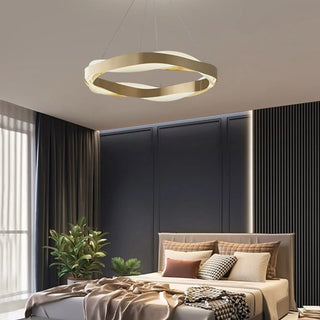
- Linear pendant lighting is the natural choice for long islands and rectangular dining tables, because one continuous fixture spans the surface more evenly than a row of matched multiples.
- Glass globe pendants are casual, practical and easy to clean, which makes them a strong fit for an everyday kitchen island.
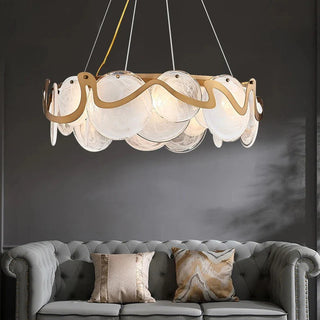
- Crystal and statement dining room pendant lights are scaled to the table and anchor a dining room the way a chandelier would.
- Clustered mini pendants group three or more small fixtures over a bar counter or breakfast nook, a look that sits comfortably in the pared-back Nordic lighting range.
- Staircase pendant lights are slim vertical fixtures for stairwells and tall entries where a full chandelier would be too much.
Where the ceiling is too low to give a pendant its proper drop, a flush mount ceiling chandelier covers the same surface without eating the headroom the run needs.
Not sure how many pendants your island or table needs? Reach out to our team with your surface dimensions and we'll help you plan the layout.
Ready to shop the full linear pendant lineup? Browse linear pendant lights in island, table, and counter styles.
What mistakes make pendant layouts feel off?
The same handful of mistakes show up in almost every pendant layout I get asked to fix.
- Two pendants crowded into the center of a long island, leaving both ends dim.
- Uneven spacing between fixtures, so the run reads as scattered instead of intentional.
- Pendants centered too close to one end, throwing off the visual balance of the island.
- The outermost pendant on a dining table hanging directly above where a chair pulls in.
- Too few pendants for the surface length, leaving gaps of shadow between light pools.
- Correct pendant count at the wrong diameter, so the combined width misses the one third rule and the run looks undersized or bulky.
Building your linear pendant layout step by step
Plan pendant placement in this order: measure the surface, choose pendant count, size the fixtures, then confirm spacing and offset last.
- Measure the full length of the island, counter, or table.
- Choose pendant count based on the surface length using the guide above.
- Size the fixtures so their combined width is about one third of the surface length.
- Space pendants evenly, tightening the gap slightly as count increases.
- Center the full run with even offset from each end.
- For a table, leave extra room on each end so the outer pendants clear the chairs.
- Add up the lumens across the run and check the total against the surface size.
- Step back and check the layout from across the room before finalizing.
About the author
Konstantin Khanasiuk is the founder of Mirodemi and works with luxury lighting and furniture day to day, helping homeowners and designers place and size fixtures for kitchens, dining rooms, and living spaces. He writes from hands-on experience selecting and shipping fixtures for real rooms, not showroom mockups.
Frequently asked questions
How many pendant lights should hang over an island?
A kitchen island under 4 feet usually needs 2 pendant lights, a standard 4 to 7 foot island takes 2 to 3, and an island over 7 feet needs 3 or more spaced evenly. Roughly one pendant per 24 to 30 inches of island length is a good cross-check on that count.
What size pendant lights work over an island?
The combined width of all the pendants over an island should equal about one third of the island's length. A single pendant carrying that job alone usually measures 18 to 32 inches in diameter, while multiples usually land at 10 to 16 inches each.
How far apart should linear pendants be spaced?
Two linear pendants sit 24 to 30 inches apart, center to center. Three tighten to 20 to 26 inches, and four or more sit 18 to 24 inches apart.
How far from the ends of the island should pendants sit?
A pendant run over an island is centered with about 12 to 18 inches of offset from each end of the counter. That offset keeps the lighting looking balanced rather than pushed to one side.
How far should the outer pendant sit from a dining chair?
A pendant run over a dining table leaves 18 to 24 inches of offset from each end of the table. That clearance keeps the outermost pendant from hanging directly above where someone pulls in a chair.
How bright should pendant lighting over an island be?
A standard kitchen island of about 24 square feet wants 2,500 to 3,000 total lumens across the whole pendant run. A large island near 35 square feet wants 3,500 to 4,500 lumens, and a dining table around 30 square feet wants 2,500 to 3,500.
Which pendant style works best over a long island or rectangular table?
A single linear suspension is the strongest choice over a long island or rectangular dining table. One continuous fixture spans the surface more evenly than a row of matched multiples, and it keeps the ceiling from looking busy.
Sources
Residential lighting placement guides: pendant count and spacing conventions by island and table length Kitchen and dining lighting design guides: edge offset conventions for pendant runs In-house Mirodemi sizing rules: pendant diameter relative to surface length, and total lumen targets by surface area
Not sure which fixture fits your space?
Send room size, ceiling height and a photo. Our team will suggest sizes and models that fit your project.
Not sure which fixture fits your space?
Send room size, ceiling height and a photo. Our team will suggest sizes and models that fit your project.