


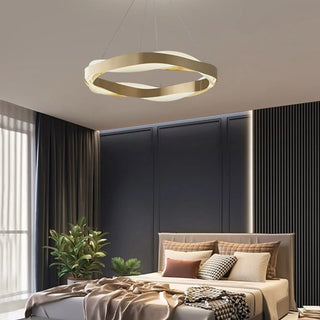
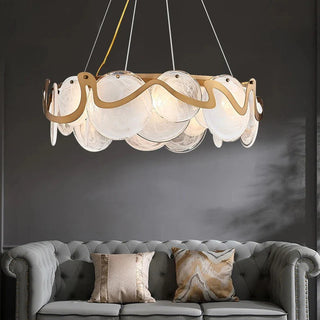

Quick answer: Amber glass tints light a warm honey-gold, while smoked (smoky gray) glass mutes and softens it toward a cooler, moodier tone — both sit between clear crystal and fully opaque shades, letting some light through the glass itself rather than only around it. They suit living rooms, dining rooms, bedrooms, and hospitality spaces, and a round 24-inch metal-and-glass chandelier in either tone typically runs $1,100–$1,900.
What tinted glass changes about a room
Clear glass and crystal chandeliers scatter and refract light without altering its color; amber and smoked glass do both. Amber glass has a warm honey or whiskey tone that carries through to the light itself, giving a room a golden, low-lit-lounge feel even at a standard warm-white 3000K bulb temperature. Smoked glass runs the opposite direction — a translucent gray that dims and cools the light passing through it, giving a moodier, more industrial-modern feel without going as dark as a fully opaque black shade.
Mirodemi's Huy is a 23.6-inch round chandelier in metal and amber glass, hung on an adjustable 31.5-inch cord, rated for a 10–20 m² room and suited to living rooms, dining rooms, bedrooms, and hospitality spaces like restaurants and hotel lobbies. Related smoked-glass pieces in the same general format include the Amriswil and Adrano, both described as contemporary smoky gray chandeliers.
Choosing amber vs. smoked
- Amber suits rooms that lean warm already — wood tones, brass hardware, terracotta or rust accent colors — and works well in spaces meant to feel relaxed and inviting, like a living room or bar area.
- Smoked/smoky gray suits cooler, more contemporary palettes — black metal, concrete, dark wood — and reads more sophisticated or moody than amber, making it a common choice for dining rooms and statement bedroom fixtures.
Both tones are less visually "loud" than a bold color like the multicolor Murano styles, which makes them easier to use as a room's primary chandelier rather than a single accent piece.
Where to use it
Round tinted-glass chandeliers in the 20–24 inch range work well centered over a round or square dining table, as a bedroom's central fixture, or in a living room seating area. Because the tinted glass diffuses rather than blocks light, these fixtures generally provide enough ambient light to serve as a room's main source in small-to-medium spaces (10–20 m², or roughly 110–215 sq ft) — for larger rooms, plan to supplement with lamps or recessed lighting.
What to check before ordering
- Dimming and color temperature. Tinted glass chandeliers are frequently sold at a fixed warm 3000K and non-dimmable — if you want to adjust brightness or warmth, confirm before buying.
- Bulb type. Small-base bulbs like E12 are common; check that replacements are easy to source locally.
- Room application. Confirm the fixture is rated for your intended space — hospitality-rated pieces are often suited to both residential and commercial (restaurant, hotel) use, which can be a useful cue for durability.
FAQ
Does amber or smoked glass make a room feel darker?
Both reduce the light's clarity slightly compared to clear glass, but not dramatically — think of it as tinting the mood rather than meaningfully lowering brightness. If the fixture is your only ceiling light, pair it with lamps for task lighting.
Can I mix amber and smoked glass fixtures in the same home?
Yes, as long as they're in separate rooms or zones — mixing both tones in the same sightline can compete visually. Pick one tone per connected space (for example, open living-dining areas) for a cohesive look.
Are these fixtures dimmable?
Many are not — check the spec sheet, since a fixed color temperature and brightness is common for this style at this price point.
Not sure which fixture fits your space?
Send room size, ceiling height and a photo. Our team will suggest sizes and models that fit your project.
Not sure which fixture fits your space?
Send room size, ceiling height and a photo. Our team will suggest sizes and models that fit your project.