



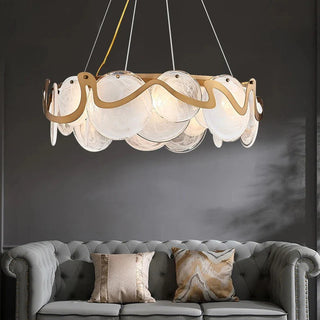

Quick answer: Spiral cascade chandeliers hang tiered strands of material — shell discs, crystal, or glass — from a frame so the piece appears to twist as it falls, rather than dropping in a single straight column. They're built for stairwells, foyers, and other double-height spaces, and a mid-size version typically runs $2,000–$2,800.
What makes a chandelier "spiral"
A standard cascade or tiered chandelier drops its elements in even, stacked rings; a spiral design instead staggers each tier's rotation slightly, so the strands appear to wind downward like a corkscrew rather than falling straight. The effect depends on real vertical drop to read clearly — a spiral chandelier compressed into a low-ceiling room loses the twisting silhouette that defines the style.
Mirodemi's Nacara Capiz Shell Spiral Cascade Chandelier is a distinctive example: translucent natural capiz shell discs hang in tiered strands from a baked-finish iron frame, available in a 51-inch or a full 79-inch drop, lit by twelve E14 LED bulbs. The shell surface catches and softly diffuses light as it turns, giving the piece a coastal, light-luxury character rather than the harder sparkle of cut crystal.
Where the look fits
- Stairwells, where the vertical drop lets the spiral shape read clearly from multiple floors as you move past it.
- Foyers and double-height entries, as a single dramatic focal point visible from the front door.
- Lobbies and open living rooms with tall ceilings, where the fixture has enough vertical room to hang at its full designed length.
A spiral cascade needs real height to work — in a standard 8-foot room, the design reads as merely a tiered chandelier rather than a true spiral, so it's best reserved for stairwells, foyers, or rooms with at least 12–15 feet of ceiling height.
Sizing and placement
For an open stairwell, choose the longer drop length and hang the fixture so its lowest point clears stair-tread head height by at least 7 feet, checked against your specific stair run. For a foyer or double-height living room, center the fixture over open floor space rather than a piece of furniture, and confirm your total ceiling height against the fixture's listed drop before ordering, since most spiral designs ship in a small number of fixed lengths rather than continuously adjustable rods.
What to check before ordering
- Material. Natural capiz shell has soft, irregular variation from piece to piece, which is part of the material's character rather than a defect — expect some variation in shell color and pattern between individual units.
- Mounting method. Some spiral chandeliers can also mount semi-flush for lower ceilings; check the specific fixture's spec sheet if you're unsure your space has enough height for a full hanging installation.
- Bulb count. Multi-bulb spiral fixtures (a dozen or more small bulbs is common) mean more individual points to replace over time — confirm the bulb type and count before ordering so replacements are easy to source.
FAQ
How is a spiral chandelier different from a raindrop chandelier?
A raindrop chandelier hangs individual glass or crystal drops on separate cords at staggered lengths; a spiral chandelier hangs tiered strands from a single frame arranged to visually twist as they descend. Both create a cascading look, but the spiral's rotation is the defining feature.
Can a spiral chandelier be shortened for a lower ceiling?
Some models offer semi-flush mounting or a shorter size option; check with the manufacturer before ordering if your ceiling height is close to the fixture's minimum drop, since cutting the frame itself is not typically possible.
Is capiz shell durable for everyday use?
Yes, for indoor use — capiz shell is a common material in decorative lighting and holds up well indoors, though like any natural material it should be dusted gently rather than scrubbed.
Planning a stairwell chandelier?
Send your ceiling height and a photo of the stairwell. We will suggest size, drop length and models that fit.
Planning a stairwell chandelier?
Send your ceiling height and a photo of the stairwell. We will suggest size, drop length and models that fit.