



Quick answer: Frosted, or "obscure," glass chandeliers use translucent rather than transparent shades, so the bulb itself disappears into a soft, even glow instead of showing as a bright point of light. They suit living rooms, dining rooms, bedrooms, and kitchen islands, and a round three-tier version in the 20–35-inch range typically costs $1,300–$1,700.
What "obscure" glass means
Clear glass and crystal chandeliers let you see the bulb and let light scatter and refract sharply; frosted or obscure glass treats the surface so it's translucent rather than transparent, diffusing the light into a soft, cloud-like glow with no visible bulb points. The effect is closer to a paper lantern than a crystal fixture — gentler, more ambient, and less prone to glare when viewed directly.
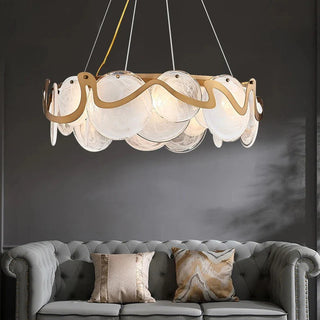
Mirodemi's Peone Round Obscure Glass Chandelier illustrates the look: circular frosted-glass shades hang from a round iron base in three diameters (roughly 20, 28, and 35 inches) at a fixed height, using E12 LED bulbs in warm or cool light. Because the frosted surface does the diffusing work, the fixture reads as calm and evenly lit from any angle rather than throwing hard-edged shadows.
Where the look fits
- Living rooms and bedrooms, where soft, glare-free ambient light matters more than a sparkling statement piece.
- Dining rooms, as a gentler alternative to a crystal or clear-glass chandelier when the room already has other reflective or busy surfaces.
- Kitchen islands, where the even diffusion avoids the harsher glare that a bare or clear-glass bulb can produce at eye level.
Because frosted glass is inherently more understated than crystal or clear glass, this style works best as a room's primary source of soft ambient light rather than a dramatic focal point — pair it with accent lighting (lamps, sconces) if you want a layered look with more visual drama elsewhere in the room.
Sizing and placement
Match the diameter to the room: a 20-inch version suits a smaller bedroom or breakfast nook, while the 28- or 35-inch sizes work for a full dining room or a larger living room seating area. The applicable room size for this style is typically 15–30 square meters (roughly 160–320 square feet) per fixture — for larger open-plan rooms, consider two smaller fixtures rather than one oversized piece to keep the light distribution even.
What to check before ordering
- Fixed height. Some obscure-glass designs, including tiered round styles, ship at a fixed drop height rather than an adjustable rod — confirm the listed height works for your ceiling before ordering, especially in a room with lower ceilings.
- Bulb type and count. Small-base bulbs like E12 are common; check how many the fixture takes and confirm replacements are easy to find locally.
- Dimming. Most obscure-glass fixtures are non-dimmable at a fixed warm or cool color temperature selected at checkout — decide on your preferred light temperature in advance.
FAQ
Is obscure glass the same as frosted glass?
Yes, "obscure" is the industry term most often used interchangeably with "frosted" — both describe glass treated to be translucent rather than clear.
Does frosted glass show fingerprints or dust more than clear glass?
Dust shows less on frosted glass than on clear glass or polished crystal, since the matte surface doesn't reflect light the same way — it's a genuinely lower-maintenance option in that respect.
Can frosted glass chandeliers be paired with crystal fixtures elsewhere in the home?
Yes, as long as they're in separate rooms — mixing a soft, diffused fixture with a sparkling crystal one in the same sightline can feel visually inconsistent, but using each style in a different room works well.
Not sure which fixture fits your space?
Send room size, ceiling height and a photo. Our team will suggest sizes and models that fit your project.
Not sure which fixture fits your space?
Send room size, ceiling height and a photo. Our team will suggest sizes and models that fit your project.