


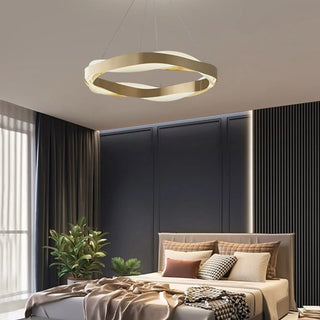
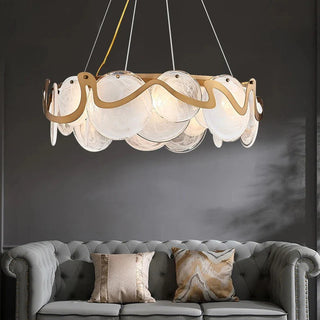

Quick answer: Size a drum chandelier to about one-half to two-thirds the width of the table or space beneath it, and hang the lowest point 30–36 inches above a tabletop, or roughly 7 feet above the floor in open spaces. Drum designs span crystal, glass-ball, and LED styles in gold, chrome, and black, most dimmable, running from around $600 to $2,300+.
What is a drum chandelier?
A drum chandelier wraps its light source — crystal strands, glass, or LED elements — in a cylindrical shade or open metal ring, similar in silhouette to a drum. The shade conceals the bulbs and diffuses light down and outward, which gives a more even, glare-free spread than an open, uncovered chandelier.
That even spread is the main reason people choose a drum shape: it reads as tailored and modern, and it doesn't throw the same hard glare into your eyes that an exposed-bulb chandelier can.
Single-tier vs. two-level drums
Most drum chandeliers are single-tier: one cylindrical shade, sized to the room or table below. For larger or double-height spaces, two-level drum designs stack a second, usually smaller, drum below or above the first, adding scale without simply making one shade very large.
Single-tier drums suit standard dining rooms and bedrooms; two-level designs suit great rooms, larger dining rooms, and foyers with more vertical space to fill.
Materials and finishes
- Crystal-wrapped drums — strands or blocks of crystal inside or around the shade, for a fixture that still sparkles despite the enclosed silhouette.
- Glass drums — a solid or textured glass shade, for a softer, more uniform glow.
- LED block or ring drums — integrated LED light sources built into the drum structure itself, often the most energy-efficient option.
Finishes run gold, chrome, and black, with black-and-crystal combinations being a popular contemporary pairing.
How to size one
- Measure the table or floor space. For a dining table, the drum's diameter should be about half to two-thirds the table's width — for a 40-inch-wide table, that's roughly a 20–27 inch drum.
- Set the hanging height. Over a table, hang the lowest point 30–36 inches above the tabletop. In open floor space (an entryway or seating area), aim for the lowest point to sit about 7 feet above the floor.
- Check ceiling height. For every foot of ceiling height above 8 feet, add roughly 3 inches to the chandelier's total height (shade plus rod or chain) to keep proportions right.
Where drum chandeliers work best
- Dining room: a single-tier crystal or glass drum centers the table without the visual clutter of an open tiered chandelier.
- Bedroom: a black or gold crystal drum works as a statement piece over a seating nook or in place of a ceiling fan.
- Living room: a two-level drum suits larger rooms or double-height ceilings where a single small shade would look underscaled.
Are drum chandeliers dimmable?
Most current drum designs, especially LED and crystal-LED hybrid models, are dimmable — worth confirming on the specific listing, since it affects both ambiance and whether you'll need a compatible dimmer switch installed.
Bottom line
A drum chandelier is the shape to choose when you want a chandelier's presence without an open, glary silhouette. Size the drum to your table or room using the half-to-two-thirds rule, keep the 30–36 inch table clearance or 7-foot floor clearance, and pick crystal for sparkle or glass/LED for a softer, more even glow.
Not sure which fixture fits your space?
Send room size, ceiling height and a photo. Our team will suggest sizes and models that fit your project.
Not sure which fixture fits your space?
Send room size, ceiling height and a photo. Our team will suggest sizes and models that fit your project.