




Quick answer
Choose a single chandelier over a kitchen island when the island is under 6 feet, when the kitchen opens onto a dining or living space that needs one visual anchor, or when the ceiling is 9 feet or higher. Choose multiple pendants when the island runs 7 feet or longer, when you want even light along the whole work surface, or when the ceiling is 8 feet and headroom is tight. Both hang 30 to 36 inches above the counter.
What is the actual difference between a chandelier and pendants over an island?
The words get used loosely, so it helps to define them by function rather than by looks. A chandelier is one fixture with multiple light sources inside a single body, fed by one canopy and one electrical box. Pendants are separate fixtures, each with its own canopy, its own box or its own position on a shared track or bar, hung in a row.
That distinction drives almost every practical consequence. One box means one decision about placement and no risk of spacing looking off by an inch. Three boxes mean three chances to get the rhythm right and three chances to get it wrong, but also far more flexibility if your island is not perfectly centred in the room — which, in renovated kitchens, it usually isn't.
Chandelier versus pendants: side by side
| Consideration | Single chandelier | Multiple pendants |
|---|---|---|
| Best island length | 4–6 ft (or long linear up to 10 ft) | 6–10 ft |
| Electrical boxes needed | 1 | 2–3 |
| Light distribution | Concentrated at centre, softer at ends | Even along the full length |
| Clearance above counter | 30–36 in | 30–36 in |
| Works at 8 ft ceiling | Only low-profile or linear types | Yes, with shades under 14 in tall |
| Typical spend at Mirodemi | $606–$3,500 for one fixture | $595–$900 each, ×2–3 |
| Visual effect | One statement, reads as jewellery | Rhythm and repetition, reads as architecture |
When is a single chandelier the better choice?
Three situations point clearly to one fixture. First, a short island: below about 6 feet, two pendants start to look cramped and three are out of the question, so a single well-scaled chandelier fills the space more gracefully. Second, an open-plan kitchen where the island is visible from the sitting area — a row of three pendants competes with whatever hangs over the dining table, while one chandelier holds its own as a focal point. Third, a high ceiling, where a fixture with real vertical presence has room to breathe and a flat row of small pendants would look undersized.
There is also an electrical argument. If your kitchen already has one junction box centred over the island and you would rather not open the ceiling, a chandelier or a long linear fixture is the low-disruption route. Adding two more boxes means drywall work.
When do multiple pendants win?
Long islands are the clearest case. Past about 7 feet, a single round fixture leaves the ends of the counter noticeably dimmer, and no amount of extra wattage in the middle fixes the falloff. Three pendants spaced 24 to 30 inches apart put light exactly where hands work.
Pendants also win on flexibility. You can adjust individual heights slightly to follow a sloped ceiling, stagger them around a range hood or a structural beam, or replace one damaged shade without touching the rest. And at an 8-foot ceiling they are usually the safer bet, because a compact 10 to 12 inch shade fits inside the available headroom where most chandeliers do not.
What size should each option be for your island?
For a single chandelier, a workable rule is to make the fixture's widest dimension roughly one-half to two-thirds of the island's length, and never wider than the island itself minus 12 inches. A 5-foot island suits a 30 to 36 inch fixture; a 7-foot island suits a 42 to 55 inch linear piece.
For pendants, size each shade at 10 to 16 inches in diameter depending on count, and keep their combined width under half the island length. Two 16-inch globes on a 7-foot island total 32 inches of the 84 available, which sits comfortably inside that limit.
| Island length | Single chandelier width | Pendant option | Combined pendant width |
|---|---|---|---|
| 4 ft / 48 in | 24–30 in | 1 pendant | 14–18 in |
| 5 ft / 60 in | 30–36 in | 2 pendants | 24–30 in |
| 7 ft / 84 in | 42–55 in linear | 2–3 pendants | 30–42 in |
| 9 ft / 108 in | 55–70 in linear | 3 pendants | 36–45 in |
How high do you hang each one?
The clearance rule is the same for both: 30 to 36 inches from the countertop to the lowest point of the fixture. Take the low end at an 8-foot ceiling and the high end at 9 feet or above. What differs is how much of that budget the fixture body consumes. A three-tier crystal chandelier may be 24 inches tall on its own, leaving almost nothing for the rod at a standard ceiling, whereas a 2.8-inch-deep linear tube leaves you free to hang it wherever you like.
One extra step applies to chandeliers only: check the fixture's centre, not just its bottom. A wide chandelier hung over a narrow island can put its outer arms beyond the counter edge, where someone will eventually walk into them.
Does one option cost more than the other?
Not reliably, which surprises people. A single quality chandelier over an island typically runs from around $606 for a minimalist line fixture to $3,500 or more for alabaster or Murano glass. Three pendants at $595 to $900 each land in the same $1,800 to $2,700 band. The real cost difference is usually electrical labour: adding two junction boxes to an existing ceiling can add several hundred dollars and patching work.
Where a chandelier does have an edge is in the value-per-fixture ratio. When your budget concentrates on one piece rather than splitting three ways, you can generally afford better materials — solid brass instead of plated steel, real alabaster instead of resin.
Can you mix a chandelier and pendants over the same island?
You can, but keep it deliberate. The pattern that works is a single chandelier over the island paired with small pendants elsewhere in the kitchen — over a sink, a coffee station or a breakfast nook — where the chandelier stays the clear hierarchy and the pendants are secondary. The pattern that rarely works is mixing both directly over the same island, which reads as indecision unless the finishes and shade shapes match exactly.
If you want variation over one island, a better route is a single linear chandelier that contains several visually distinct light sources within one body. It gives the rhythm of pendants with the coherence of one fixture.
Which Mirodemi fixtures suit each approach?
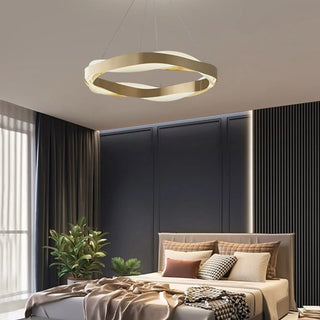
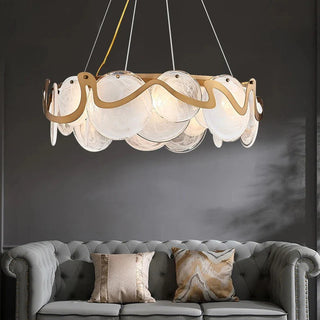
On the chandelier side, the Ondara curved LED wave chandelier from $1,014 spans 39.4 to 78.7 inches in black or gold and is designed to sit over an island as one continuous gesture. The Sellara alabaster oval chandelier from $3,488 covers 39.4 to 63 inches for a heavier statement. Both live in our kitchen island chandeliers range alongside crystal, linear and drum designs.
On the pendant side, the Elara white silk pendant from $608 comes in six diameters so you can match shade size to island length, and the Liora glass linear pendant from $1,119 offers a five- or six-light bar at 39.4 or 47.2 inches, which is the hybrid answer for a long island. See the full spread in pendant lights for kitchen islands and modern linear pendant lighting.
FAQ: chandeliers and pendants over a kitchen island
Is a chandelier over a kitchen island out of style?
No. Island chandeliers have grown as open-plan kitchens turned into the main living space of the house, and a single sculptural fixture now reads as more current than a row of identical drum shades. What has dated is the ornate multi-tier crystal chandelier in a small kitchen, not the chandelier itself.
How many pendants do I need for an 8-foot island?
Three, spaced 24 to 30 inches apart from centre to centre, with at least 6 inches of margin between the outermost pendant and each end of the island. Two pendants can work if each shade is 16 inches or wider, but you will notice the light dropping off toward the counter ends.
Should the island fixture match the dining room chandelier?
Match the metal finish and the general design language, but not the fixture itself. Two identical chandeliers in sight of each other cancel one another out. A common approach is one statement piece over the dining table and a quieter linear fixture over the island, both in the same brass, black or chrome.
Does a chandelier give enough light for food prep?
On its own, usually not. An island needs roughly 70 to 80 lumens per square foot of counter for task work, which a decorative chandelier rarely delivers evenly. Pair it with recessed downlights or under-cabinet strips, and specify a dimmable driver so the chandelier can handle ambience while the downlights handle chopping.
What if the island is not centred in the room?
Centre the fixture on the island, never on the room or the ceiling. An off-centre island with a light aligned to the room reads as a mistake from every angle. If the existing junction box does not line up, a swag kit, a track, or a fixture with an adjustable canopy will move the light without new wiring.
About the author
Konstantin Khanasiuk is the founder of Mirodemi and has specified lighting for residential and hospitality interiors across the United States and Europe, from single-island kitchens to double-height staircases. He works directly with the workshops that build Mirodemi fixtures, which is why the dimensions and prices in these guides come from real product specifications rather than general rules of thumb. Questions about a specific island can be sent to the Mirodemi design team before you order.
Not sure how many pendants your island needs?
Share your island length and ceiling height. We will suggest pendant size, count and spacing with matching models.
Not sure how many pendants your island needs?
Share your island length and ceiling height. We will suggest pendant size, count and spacing with matching models.