



Quick answer: Bubble glass chandeliers gather a cluster of dimpled, globe-shaped glass shades on a single frame, so the surface of each globe scatters light unevenly — closer to the look of rising bubbles than a smooth, formal glass shade. They suit dining rooms, foyers, and stairwells as a soft, textural focal point, and typically run $2,000–$2,500 for a 10-light cluster in champagne or clear glass on a brass frame.
What "bubble glass" means
The term describes glass that's been shaped with a dimpled, pockmarked, or softly faceted surface rather than left smooth. Light passing through or reflecting off that texture breaks up into small highlights across the globe, which is where the "bubble" comparison comes from — each sphere looks like it's caught mid-rise, catching light unevenly across its dimpled surface.
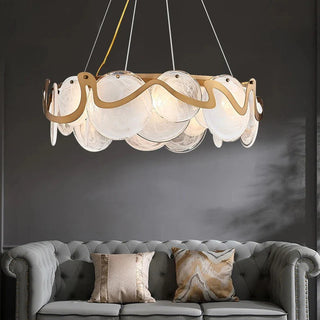
Mirodemi's Bollara pairs ten champagne-luster glass globes with a burnished brass steel frame, each globe measuring about 27.8 inches wide by 23 inches tall as a cluster, with a compact 5.9-inch canopy. It ships with an adjustable rod set — two 18-inch, two 12-inch, one 6-inch, and one 3-inch rod — so the hanging height runs from about 24 to 84 inches, wide enough to work over a standard 8-foot ceiling or drop into a stairwell.
Where the look fits
Because the globes are irregular rather than perfectly uniform, bubble glass chandeliers read as more relaxed and organic than a crisp crystal piece, while still working in a formal room thanks to the metal frame and warm glass tone. They pair naturally with:
- Dining rooms and foyers, where the cluster becomes the main visual anchor over a table or entry console.
- Living rooms with double-height ceilings, using the longer rod combinations to bring the cluster down to a comfortable viewing height.
- Stairwells, where the adjustable drop range lets the cluster hang safely above a landing while still reading as a single grouped shape from below.
Sizing and placement
For a dining table, center the cluster above the table and keep the lowest globe 30–36 inches above the tabletop — the same clearance rule used for any dining chandelier. For an open stairwell, use the longer rods so the lowest point clears head height on the stairs by at least 7 feet, and confirm the total drop range against your ceiling height before ordering, since rod sets are usually fixed rather than continuously adjustable.
Because the ten-globe cluster spans nearly 28 inches across, leave at least a foot of clearance on every side to walls, beams, or cabinetry so the organic shape doesn't feel boxed in.
What to check before buying
- Bulb count and type. Each globe typically holds its own small bulb (E12 is common), so a 10-light cluster means ten individual light points — confirm whether replacement bulbs are standard or specialty.
- Dimming. Bubble glass chandeliers are frequently sold non-dimmable at a fixed warm color temperature; if you want adjustable brightness, ask before ordering.
- Frame finish. A burnished or antique brass frame reads warmer and more traditional; a polished chrome or black frame gives the same bubble-glass texture a cooler, more contemporary edge.
FAQ
Is bubble glass the same as Murano glass?
No. Murano glass is defined by where and how it's made (hand-blown on the Venetian island of Murano, often in bold color); bubble glass describes a texture that can appear on glass from any origin. Some Murano-style pieces do use a bubbled surface, but the two terms aren't interchangeable.
Does the cluster shape make cleaning harder?
Each globe is a separate piece on its own arm, so dusting typically means wiping each globe individually rather than one continuous shade — plan for a bit more time than a single-shade fixture.
What rooms should avoid this style?
Very small, low-ceilinged rooms can make a wide horizontal cluster feel cramped; a narrower pendant or single-tier fixture usually fits tighter spaces better.
Not sure which fixture fits your space?
Send room size, ceiling height and a photo. Our team will suggest sizes and models that fit your project.
Not sure which fixture fits your space?
Send room size, ceiling height and a photo. Our team will suggest sizes and models that fit your project.