


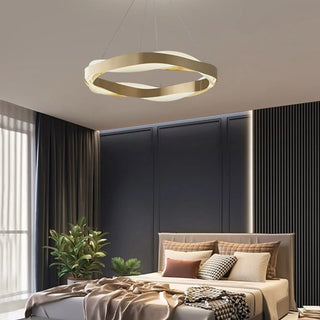
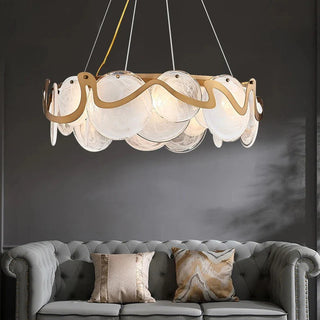

Quick answer: Alabaster lighting uses thin slices of natural stone as the shade instead of glass or fabric, so the fixture glows with a soft, honeyed light and one-of-a-kind veining when lit. It spans chandeliers, pendants, and wall sconces from about $440 to $4,900+, typically framed in brass or matte black, and suits living rooms, dining rooms, entryways, staircases, and bedrooms.
What is alabaster lighting?
Alabaster is a soft, translucent stone — usually a warm white, cream, or honey color with natural veining running through it. Cut into thin panels or shaped into a shade, it lets light pass through while softening and warming it, similar to how a paper lantern diffuses light but with the weight and texture of real stone.
Because it's a natural material, no two alabaster fixtures look exactly alike. The veining, translucency, and tone vary piece to piece, which is part of the appeal for anyone who wants a fixture that reads as one-of-a-kind rather than mass-produced.
Why it's trending now
Alabaster fits a broader shift toward natural materials in luxury interiors — stone, wood, and unlacquered metal in place of glossy finishes. Compared to crystal, which sparkles and throws light outward, alabaster does the opposite: it contains and softens light, producing a warm, ambient glow rather than a sparkle. That makes it a natural fit for rooms designed around a quieter, more textural kind of luxury.
Forms and finishes to expect
- Chandeliers: ring, oval, and mid-century-style silhouettes are common, some with integrated LED and leather-strap or brass hardware.
- Pendants: linear tube pendants for dining tables, and single-drop pendants with a stone shade over a brass or black body.
- Wall sconces: slim vertical sconces that work in pairs, often used to flank a bed, mirror, or doorway.
- Flush mounts: square or round alabaster flush mounts for rooms with lower ceilings.
Frames are typically warm brass or matte black, chosen to let the stone itself be the visual focus.
Is it real stone?
For genuine alabaster lighting, yes — the shade is cut from natural stone, not resin or glass made to look like it. That's why pieces are described as one-of-a-kind: the veining pattern in a natural stone shade can't be exactly replicated. If a listing specifies alabaster rather than "alabaster-style" or "faux alabaster," that's a signal you're getting the real material.
Where alabaster fixtures work best
- Dining room: a linear alabaster pendant over the table gives a warm, ambient glow instead of a sparkling focal point — a deliberate contrast to a crystal chandelier.
- Bedroom: paired vertical sconces flanking the headboard replace nightstand lamps and free up surface space.
- Entryway or staircase: a single alabaster pendant or chandelier reads as a quiet, architectural moment rather than a showpiece.
Sizing and care
Size and hang alabaster fixtures the same way you would any fixture of that shape and room: a dining pendant at 30–36 inches above the tabletop, a chandelier's lowest point around 7 feet above the floor in open spaces. Because the shade is stone, it's more break-resistant than thin glass but still worth handling carefully during installation. Clean with a soft, dry cloth — avoid soaking or harsh chemical cleaners, which can affect the stone's natural finish over time.
Bottom line
Alabaster lighting trades sparkle for glow: a natural-stone shade that softens and warms light instead of scattering it. It's a strong choice if you want a fixture that feels tactile and one-of-a-kind rather than uniform, in a warm brass or matte black frame that lets the stone do the talking.
Not sure which fixture fits your space?
Send room size, ceiling height and a photo. Our team will suggest sizes and models that fit your project.
Not sure which fixture fits your space?
Send room size, ceiling height and a photo. Our team will suggest sizes and models that fit your project.